
The research in 25 seconds
Read the video summary
The video introduces research into LED lighting for greenhouse tomatoes. Plant electrical signals help identify inefficient lighting episodes; weather data feeds Random Forest models that recommend whether to turn LEDs on and at what intensity. A recreated prototype illustrates lighting scenarios. The video reports estimated lighting-cost savings of 6.08%, or €122.85, for the analysed 1,500 m² case: €2,020.61 historically versus €1,897.76 in the model-based scenario. This is a retrospective simulation for selected inefficient days in one greenhouse, using the same area, tariff and operating assumptions. Yield impact was not measured. The plant-response example and the original thesis plot represent separate example days.
The question
LED lighting is a controllable input in a greenhouse. The research explored whether information about plant activity could help identify when additional lighting is useful.
The research took place at Tomatoworld, using plant measurements from Vivent Biosignals, within the LDE Thesis Lab ‘Future of Energy in Horticulture’.
The approach
The analysis combined plant biosignals and lighting records from Tomatoworld to identify possible over-lighting. A separate modelling step used KNMI sunshine duration and global radiation to train a Random Forest classifier and regressor: first to predict LED use, then the intensity on lighting days. Open-Meteo forecasts and a separate rule-based light-sum calculator supported an advice prototype.
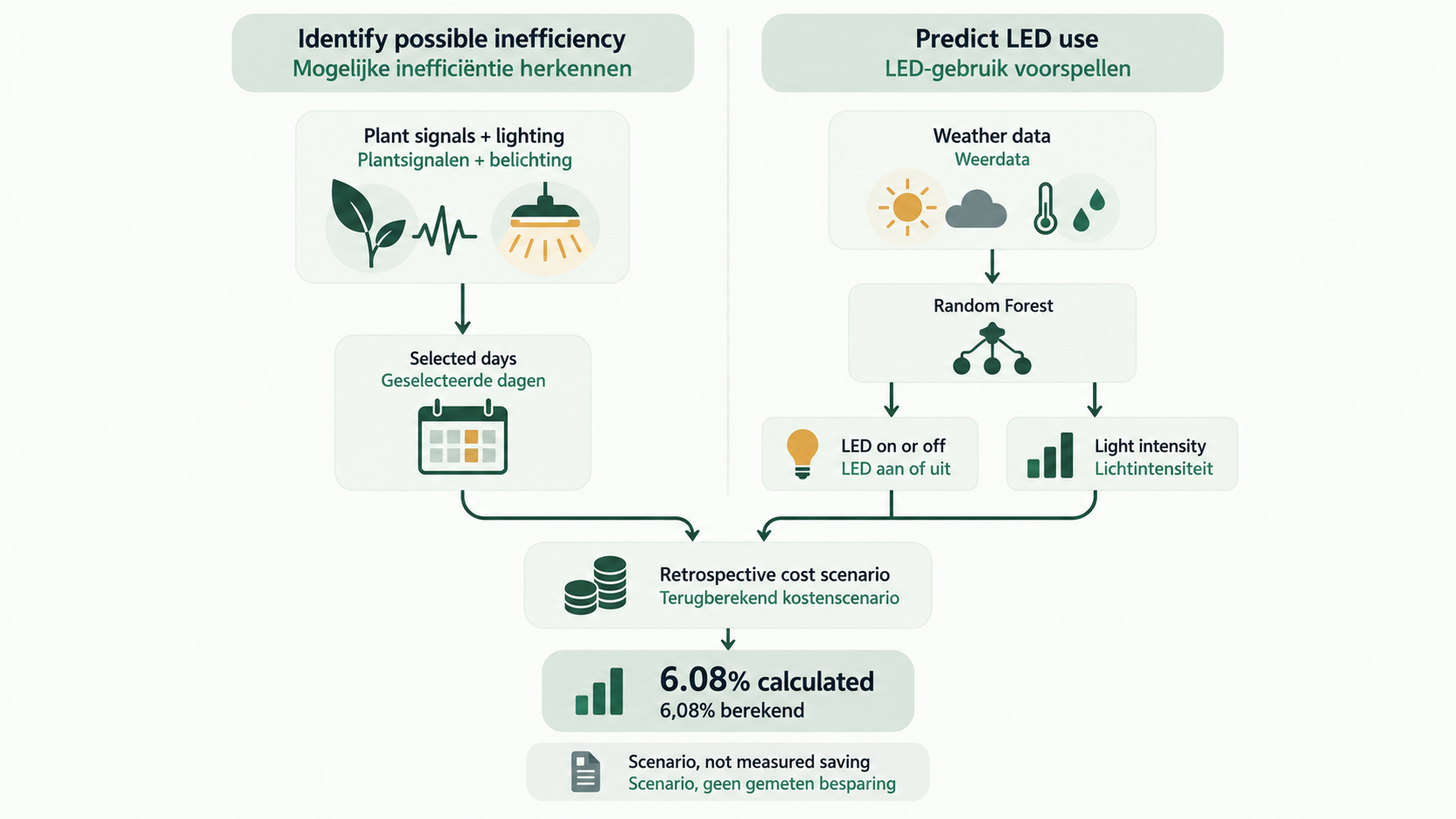
Text description of the infographic
Plant signals and lighting records help identify potentially inefficient days. Separately, Random Forest models use KNMI sunshine duration and global radiation to predict LED use and intensity, learning from historical lighting. Predictions and selected days meet in a retrospective comparison. The reported 6.08% reduction concerns calculated lighting electricity costs in this scenario, not a measured operational saving or demonstrated yield effect.
Biosignals helped identify possible inefficiency. The predictive models used weather inputs and learned from historical LED use; they did not independently establish a physiological optimum. The results describe winter data from November 2024 to February 2025 from one demonstration greenhouse.
The technical challenge
A prediction is only useful when its meaning is clear. Plant activity, environmental conditions and lighting decisions need to be considered together; a model recommendation alone does not prove a crop or energy outcome.
What came out of it
The work produced an analysis and an LED advice prototype. The thesis reports a calculated 6.08% reduction in lighting electricity costs when model recommendations replace historical intensities on the identified inefficient days. This is a retrospective scenario using fixed assumptions for lamp efficiency and electricity price, not a saving measured after deploying the system.
Calculation and result: §5.5, pp. 25–27
How to read the result
The thesis describes an exploratory study at one greenhouse. No direct yield data were used, and the models were not tested in commercial operation. The result indicates potential savings; it does not establish that crop yield would be maintained.
For the on/off model, the thesis reports 64% accuracy, with 0.81 recall and 0.29 precision for LED-on under an 80/20 split. The model frequently recommended lighting when it had not historically been used. The prototype needs further validation before controlling lighting.
Model evaluation: §5.3, pp. 19–21 · Limitations: §6.4, pp. 31–32
A lesson for product development
Useful advice needs more than a model. The inputs, assumptions and conditions under which the advice applies need to be visible too.
Code & sources
Frenk Theodorus Petrus Kester (2025). Optimizing LED Use in Greenhouse Tomato Cultivation via Plant Biosignals. Rotterdam School of Management, Erasmus University Rotterdam. Master’s thesis; student identifier removed from the website copy.
- Full master’s thesis (PDF, English) ↗
- Master-Thesis · GitHub ↗
- LDE Centre for Sustainability · Frenk Kester onderzoekt hoe AI kassen energiezuiniger maakt ↗
- GroentenNieuws · Inzet AI voorkomt verspilling energie met LED-belichting ↗
- Tomatoworld · Optimalisatie van LED-belichting via biosignalen en AI ↗
Project description checked on 16 September 2026.