
The problem
The Deep Learning coursework explored how image-classification models depend on the images and labels used for training.
The approach
The coursework used Python and Jupyter Notebooks to explore convolutional neural networks and SimCLR. The smaller projects below focus on two different classification tasks. They share the same practical question: what exactly should the model learn from these examples?
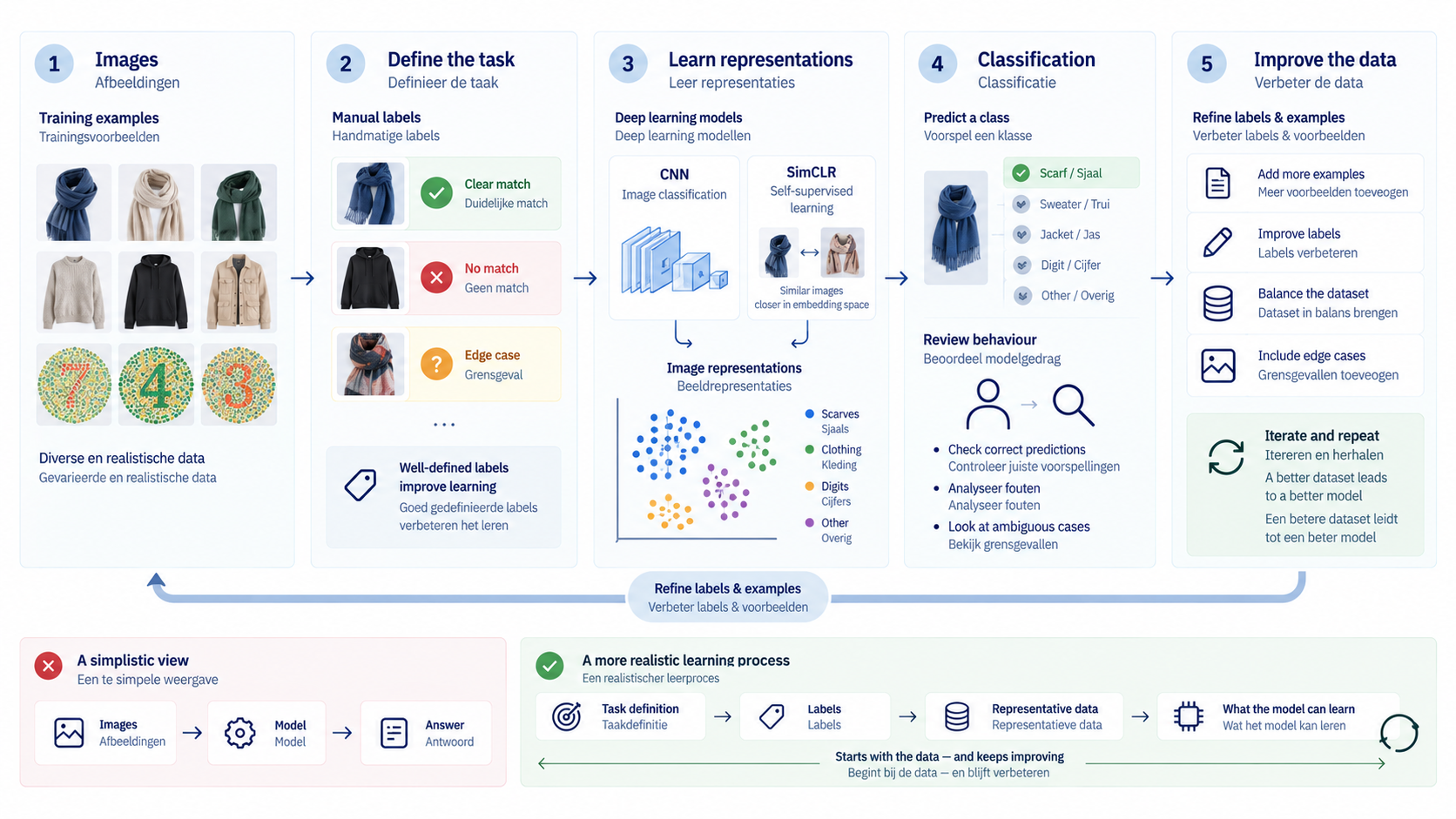
Text description of the infographic
Representative images and consistent labels define the learning task. Clear matches, non-matches and edge cases need different treatment. CNNs and SimCLR represent techniques explored in the coursework, rather than one required production pipeline. Classification and human review identify errors and ambiguous cases. These feed back into improved examples, label definitions and dataset balance. The representations and predicted classes are conceptual illustrations, not measured model results or benchmark scores.
The challenge
An architecture cannot repair an unclear task definition. Ambiguous labels and unrepresentative training examples affect what a model can meaningfully learn.
Outcome & value
Practical coursework in computer vision and a better understanding of how data quality and label definitions shape an ML project. No benchmark scores are claimed here.
Lessons learned
Define the task and examine edge cases before treating a training score as evidence that the model solves the intended problem.